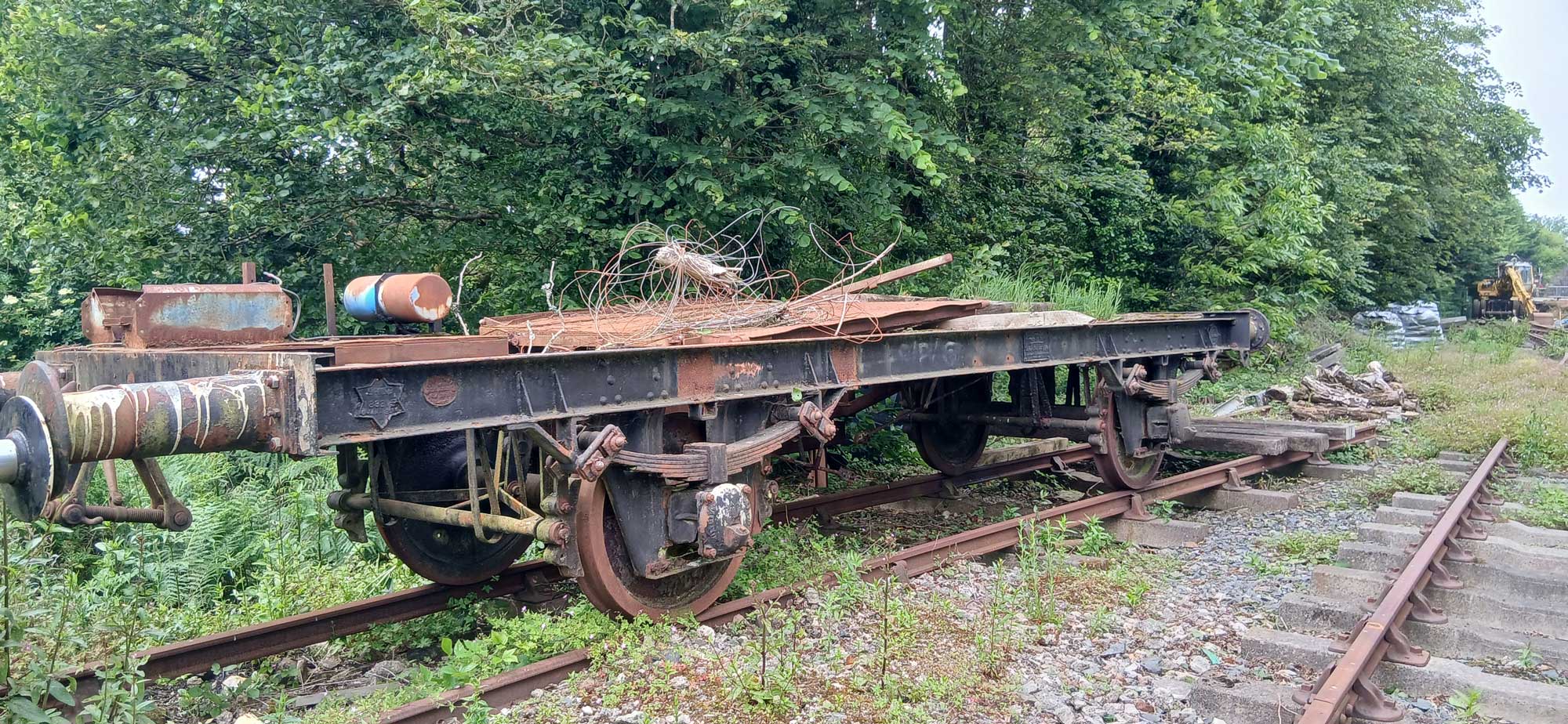


- Built by Wittmann, Hagen-Haspe, Germany, 1943 (per underframe builder’s plate)
- Originally fitted with detachable wheelsets, to allow loading of tracked military vehicles
- Fitted with double brake blocks clamping each wheel, rather than the single friction blocks used on British goods wagons — a distinctive mark of German engineering
- Recovered by the Ministry of Supply after the Second World War as one of at least 60 such wagons
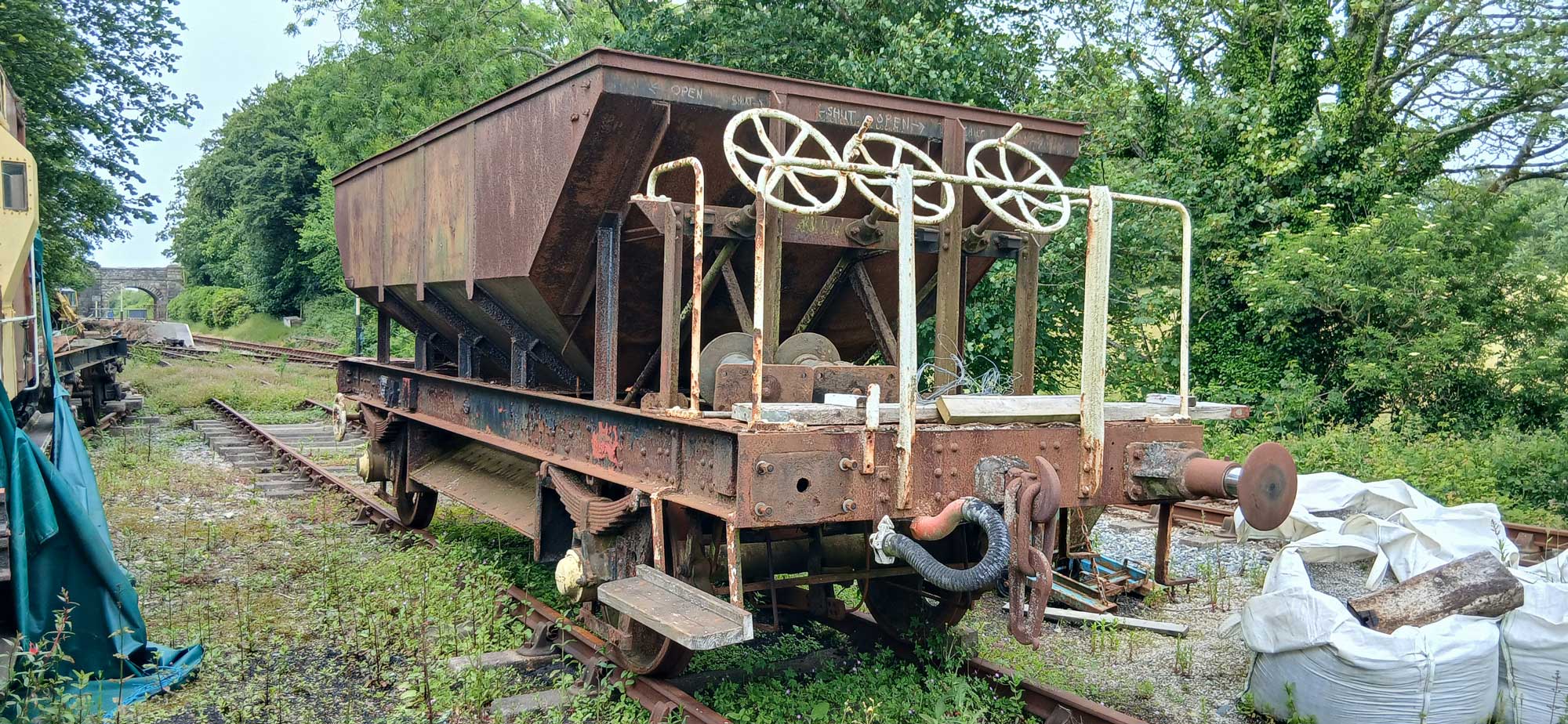
Research has established that this wagon, currently standing in a siding at Trevarno, was one of at least 60 “Tank” wagons recovered by the MOD after the Second World War and distributed around various MOD camps, with many sent to the Bramley and Kineton armament depots and used to transport munitions around the country. Originally identified as MOS/P/6, it was registered as BR(M) 188315 in January 1951 to allow it to run over the mainline network, and by 1964 was known as AD40301; while at Bramley it also transported nitric acid.
These wagons originally had detachable wheelsets to allow the loading of tracked vehicles, though it’s thought some were used to carry hydrogen peroxide, used in the fuel mix for V2 rockets. Once in Britain, the detachable wheelsets were permanently secured, and around ten wagons, including some of those stationed at Bramley and Kineton, had hydraulically powered side lifts fitted.
Bramley depot closed in 1987, but the wagon was still on site in 1993 when McAlpine & Sons were awarded the contract to dismantle and clear it. During one of his visits to the site, Sir William McAlpine pointed to the wagon and simply said “take that home” — as he was apparently in the habit of doing. It’s not known exactly when it arrived at Fawley Hill, but after an invited visit one of our members wrote to Sir William to ask whether the railway might have one of the many goods wagons there to repair and restore. He offered this Tank wagon, later adding the McAlpine-liveried flatbed wagon alongside it “to make up a load.”